Where Can I List and Sell My Workshop in India?
List and sell workshops online India: 3 practices that protect your take-home

If you list and sell workshops online India-wide through Instagram DMs and WhatsApp, you know the cost: payment screenshots, lost messages, and no clean record of who's attending. Fix it by listing where buyers already book and pay by UPI, and by keeping your own payment and attendee records.
Pick your route by creator type. A marketplace gives you reach, your own platform gives you control, and a DIY stack of payment link plus Zoom or Google Meet lets you start fast. Then judge every option by what you keep per sale after platform fees, gateway fees, and GST, not by the sticker price.
Before you start, have these ready: a workshop outline, a date and seat limit, a bank account linked to your PAN, and a rough idea of who your buyers are. The three practices below work as steps. Do them in order.
List and sell workshops online india: match route to creator type, not a top-10 list
Udemy Support (2025) shows the core trade-off in one number: instructors keep 97% on sales made through their own coupon or referral link but only 37% on sales the platform generates. To list and sell workshops online india buyers can find and pay for, first choose the route that fits how you work. A ranked list of vendors won't tell you that.
There are three routes, and you should know them before you compare anything:
- Marketplace: a platform brings buyers to you. Zoozhi works this way for in-person experiences.
- Own platform: you rent software and bring your own buyers.
- DIY stack: a payment link, Zoom or Google Meet, and a spreadsheet.
Marketplaces cost margin, not money upfront. Udemy charges nothing to create and host a course, and its shares are calculated on the net amount after taxes and app-store fees of up to 30% (Udemy Support, 2025). Its 1:1 Connect sessions pay instructors 80% of net. Own platforms flip the deal. Teachable's Starter plan costs $39 per month plus a 7.5% transaction fee (Teachable, 2026), while LearnWorlds Starter charges $5 per paid enrollment with gateway fees on top (LearnWorlds, 2026). You keep more per sale, but you have to find every buyer yourself.
For an India-native store, Instamojo (2025) offers a free Lite plan, Starter at ₹6,999 per year, and Growth at ₹14,999 per year, with GST extra. Instamojo's transaction fee documentation lists the per-payment costs, and a convenience-fee option lets you pass the fee to buyers so you receive exactly what you charge (Instamojo, 2024).
Live and hybrid workshops need more than course hosting
Most guides cover recorded courses only. Live, cohort, and hybrid workshops also need scheduling, Zoom or Google Meet links, attendance tracking, replays, and certificates. Course platforms handle replays and certificates well. A DIY stack handles links but leaves attendance to your spreadsheet.
Map your route to your situation:
- Solo coach testing demand: a DIY stack or a marketplace listing.
- Offline trainer moving online: your own platform, or a listing site with attendee management.
- Institute: your own platform with GST invoicing.
If you run sessions in person, Zoozhi lists in-person and recurring experiences from verified hosts with instant online booking, QR ticket entry, no upfront listing fees, and weekly payouts. It takes your bookings out of your DMs.
Validate before you build
Pre-sell a small first batch before you record anything or pay for a platform. KPMG in India (2017) found reskilling and online certifications was the largest online education category in 2016 at USD 93 million, nearly 38% of the market, with test preparation forecast to grow fastest at a 64% CAGR. That data is old, so check demand in your own niche.
Make checkout UPI-first, especially for Tier-2 and Tier-3 buyers. NPCI data shows UPI processed about 24.5 billion transactions worth roughly ₹29.8 lakh crore in August 2026 across 752 live banks. Hindi and regional-language workshops promoted on WhatsApp or Instagram sell best when every post points to one checkout link.
Do price and set up payments around what you keep per sale
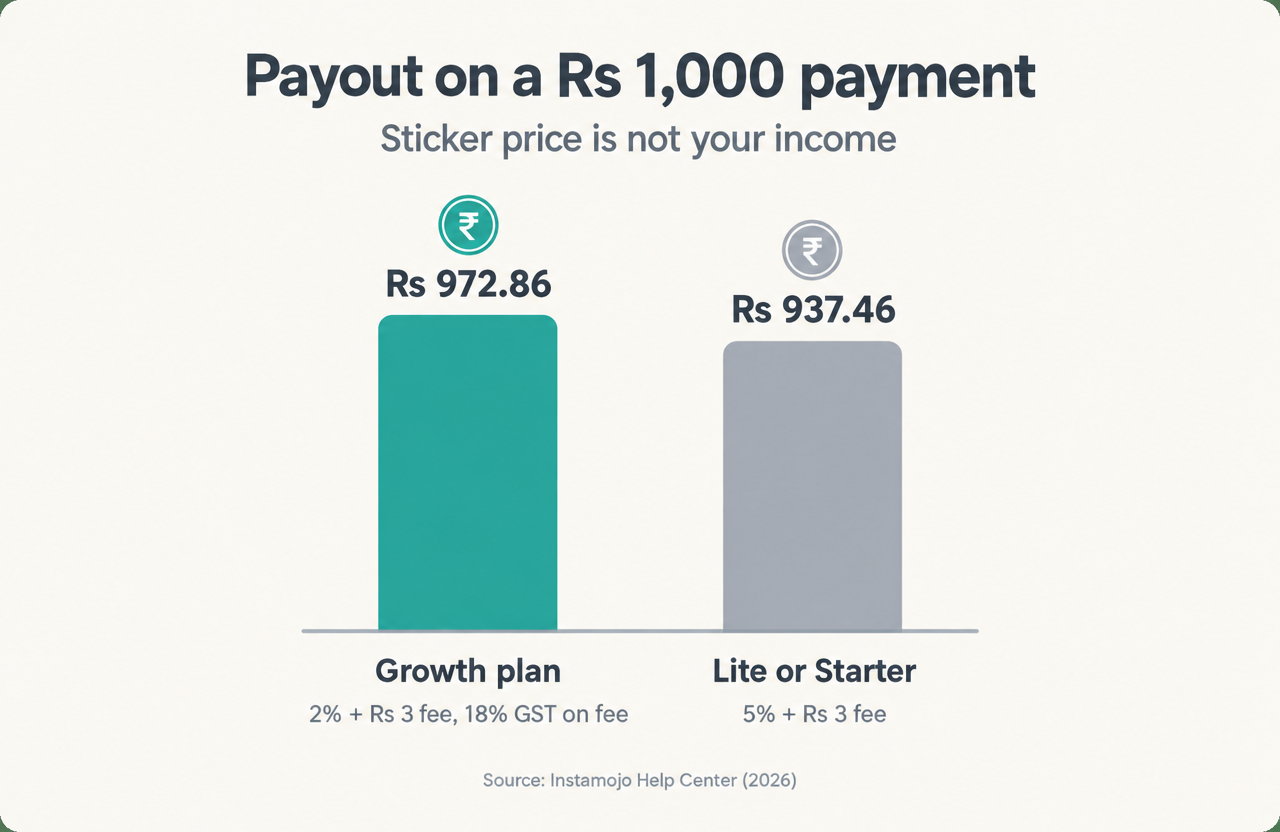
Instamojo's Help Center (2026) shows why the sticker price isn't your income: on its Growth plan, a ₹1,000 payment pays out ₹972.86 after a 2% + ₹3 fee and 18% GST on that fee. On Lite or Starter, at 5% + ₹3, the same ₹1,000 nets ₹937.46. If your workshop counts as digital goods, the fee rises to 5% + ₹3 on Growth and 10% + ₹3 on Lite or Starter, so check which category you fall under.
Set your price at a level your audience will pay by UPI without a second thought. Start lower for your first cohorts and raise the price as testimonials build. Razorpay (2026) has no setup fee or annual charge and takes a 2% platform fee plus GST. Standard UPI and RuPay debit payments carry zero MDR, but the platform fee still applies, and fees come off at source before T+1 or instant settlement.
A worked example of take-home per seat
Suppose you sell 20 seats at ₹999 and 20 seats at ₹4,999, and your fee is 2% plus 18% GST on that fee:
- ₹999 seat: about ₹23.58 deducted, so you keep about ₹975 per seat and about ₹19,508 for the batch.
- ₹4,999 seat: about ₹117.98 deducted, so you keep about ₹4,881 per seat and about ₹97,620 for the batch.
At 5% + ₹3 (plus GST), the same example leaves about ₹937 per ₹999 seat and about ₹4,701 per ₹4,999 seat. On 20 premium seats, that gap comes to roughly ₹3,600. These numbers are for illustration only. Put in your own price and fee.
TDS, GST, and fee pass-through
Under Section 194-O, e-commerce operators deduct TDS at 0.1% of gross sales, and that includes services and digital products (Income Tax Department, 2026). The Economic Times reported that the rate fell from 1% to 0.1% on 1 October 2024. Individual or HUF sellers with gross sales up to ₹5 lakh a year who furnish PAN or Aadhaar have no 194-O deduction.
Workshops are services, so the ₹40 lakh turnover threshold in Stripe's guide to India GST applies, not the ₹20 lakh threshold for goods. Once you cross it, you'll need to register and issue GST invoices. Confirm your case with a chartered accountant.
You can absorb fees or add a convenience fee. Absorbing keeps the price clean. Passing the fee on protects your margin but can put off hesitant buyers, so show the final price clearly before payment either way. If you host in person, compare your take-home against Zoozhi's pricing: no upfront listing fees, plus weekly payouts.
Do run registrations and launch from one booking link, not from your DMs

Every "is there a seat?" message and manual UPI screenshot costs you time and loses you buyers. One booking link gives you a record of who paid and who's attending.
Set up registration in this order:
- Publish one listing or checkout page with the date, time, language, format, and seat limit.
- Make UPI the first payment option.
- Send an automatic confirmation with the Zoom or Google Meet link or the venue address.
- Export your attendee list.
- Send a reminder before the session.
- Follow up with the replay or certificate for live and cohort workshops.
For in-person sessions, QR check-in gets people through the door faster. Zoozhi supports QR ticket scanning at venues alongside instant online booking.
Record hybrid sessions properly
Use a quiet room, a decent microphone, and steady lighting. Structure every session the same way: outcome, steps, practice, recap. Record the live session on Zoom or Google Meet and offer it as a replay to people who couldn't attend.
Launch to your first students
- Validate with a small pre-launch list.
- Post proof and a short preview on Instagram and YouTube.
- Use WhatsApp for reminders and questions, with every message pointing to your one booking link.
- Open early-bird seats for a fixed window.
- Collect testimonials from your first batch to sell the next one.
Don't take payments to a personal UPI ID with no record. Don't rely on one social channel for reach. Don't launch without a seat cap and a clear refund policy.
No published conversion rates exist for Indian workshop sellers, so track your own across the first batch.
Check that it worked
You've succeeded when every buyer came through one link, your attendee export matches your bank settlements, and no booking lived only in a DM. So which platform is best in India? There isn't one. Choose a marketplace for reach, your own platform for control, or a DIY stack for a first test, based on your creator type and your take-home math.
Your next step: pick your route, run one sale through the fee math, and list your first workshop this week. If you host in-person experiences, apply to list on Zoozhi.
About the author
By Suganthi, Host Success Lead